Anthropic Built Its Own Version Control After AI Agents Outgrew Git
Code Industries · Oct 15, 2026 · 4 min read
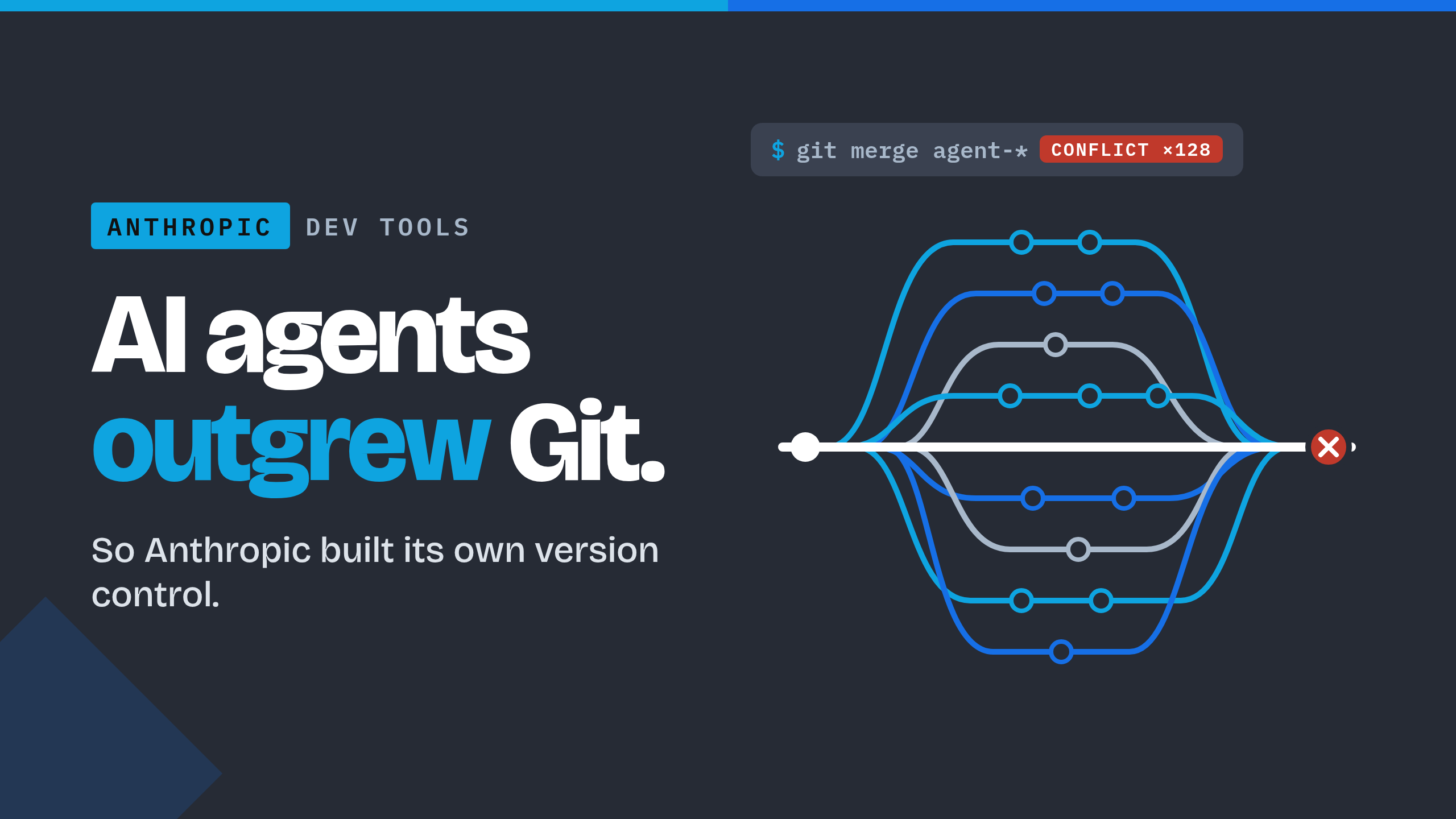
Anthropic has replaced Git in its internal monorepo with Scion, a source control system it built itself. The company says code written by AI agents was arriving faster than Git-based tools could keep up with.
For years, the slowest part of shipping software was writing the code. Anthropic says that's no longer true for its own teams, and that the slow part is now source control. In a post on its engineering blog on October 13, the company described Scion and why it built it.
The numbers behind the decision
The volume of changes grew very quickly. In May 2026, Anthropic merged about 2,500 code changes a day. By September it was merging more than 30,000 a day, roughly 12 times as many in four months, with much of the work done by Claude-based coding agents.
The repository is also large:
- About 100 GB of history on the main branch
- More than 25 GB for a compressed working copy
- About 25 million CI checkouts a day, before counting developer environments, agent sandboxes and research jobs
Anthropic estimates that serving all those checkouts naively would mean more than 600 petabytes of Git traffic a day. At its peak, the company ran several hundred Git mirrors to keep up, and they got harder to manage as merge volume kept rising.
How Scion works
Git was designed so every developer has a full copy of the repository. Scion is centralized and does most of its work on the server, which makes it closer to Google's Piper or Meta's Sapling than to Git.
- Server-side operations. The server handles commits, merges, rebases, blame and file history. Clients keep only a small local cache.
- API-first. Many CI jobs query the API instead of checking out the repository. Automated bisect and revert pipelines depend on this.
- Changesets instead of commits. A Git commit points to a snapshot of the whole tree. A Scion changeset records only the files that changed, so its cost depends on the size of the change, not the size of the repo.
- Sparse checkouts. A job pulls only the files it actually reads.
- Immutable, content-addressed data. Any server or cache can answer any request on its own.
- Three tiers. A daemon runs on each node, backed by regional caches and by main servers built on Spanner and cloud storage. Anthropic says each tier serves more than 99% of requests from cache.
The results
Anthropic reports that Scion uses 200 times less CPU and memory than the Git mirrors it replaced. CI and research checkouts now take seconds instead of minutes, and CI got back about 25% of its compute capacity.
Seven engineers built Scion, along with a code review tool called Antique, a code search tool and an access-control system for source control. Work began in January 2026, and the migration took five months. Claude did much of the coding. In one example, an early build of Claude Mythos Preview rewrote a hand-written ingestion pipeline so that it used 20 times less memory and ran four times faster. The engineers said their main job was often pushing back when the agents broke rules the system depends on.
What changes for CI/CD
Scion also changed how code gets checked and shipped. Anthropic says a traditional merge queue, where a global lock lets one change through at a time, can't handle agent-level volume. So the company now:
- Leans more on automated testing after merge and before deploy
- Lets Claude resolve most of the merge conflicts that still happen
- Has reviewers check the intent of each change rather than every line
- Runs Claude-based monitors it calls "superfans," which watch telemetry for individual components and flag subtle problems that standard alerts miss
Can you use it?
No. Anthropic says Scion only makes sense for very large monorepos and depends on its own review, search and CI systems, so it won't be released or open-sourced. Instead, it wants to share the ideas with GitHub, GitLab and the open-source community, especially richer server-side APIs and better sparse and shallow checkouts.
Anthropic expects other teams to hit similar limits within six to 12 months, and there are signs of strain elsewhere. In April, GitHub linked its own availability problems to fast growth in pull requests and commits.
The takeaway
Scion isn't a product you can adopt, but it shows where software development may be heading. As AI agents write more of the code, systems built around a human pace of commits start to break. Anthropic decided to rebuild that layer for its own use, and other large engineering teams may have to make similar choices soon.
Comments (0)
No comments yet. Be the first.