The Week the Internet Broke: 10 Security Stories From Oct 21, 2026, Fact-Checked
Code Industries · Oct 22, 2026 · 8 min read
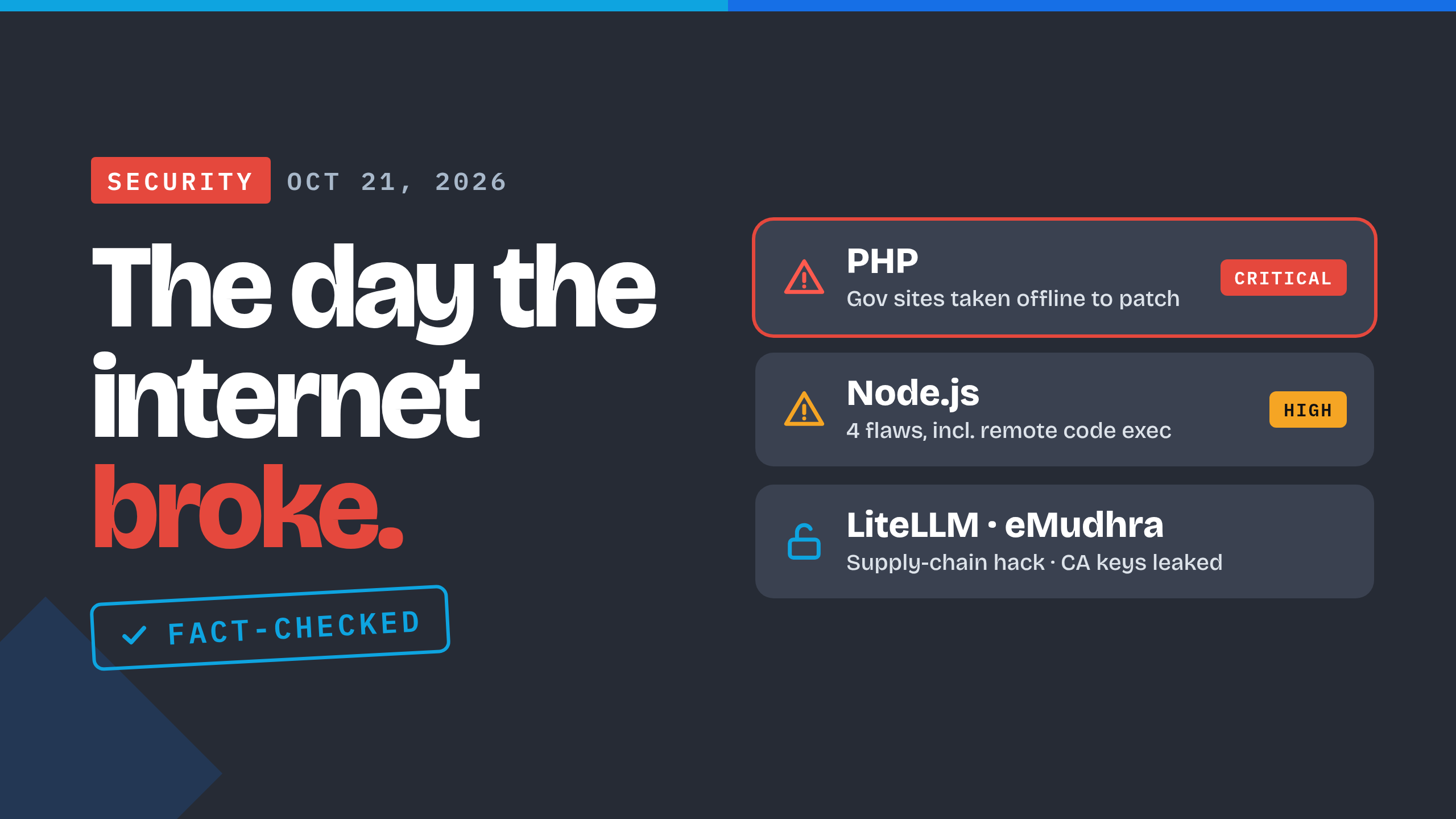
Some weeks in security are quiet. The week of October 21, 2026 was not. Within roughly 72 hours, defenders had to deal with a broken certificate authority, critical remote code execution bugs in PHP and GitLab, a poisoned AI library on PyPI, two cloud platforms leaking customer secrets, an actively exploited media server chain, and two data exposures in India.
A viral post summed it up as "the internet broke today." That is close enough to the mood, but several of the numbers going around are wrong or missing context. Below is each story, checked against vendor advisories and primary reporting, with what you should actually do.
1. eMudhra: certificate authority keys that anyone could compute
On October 17, security researcher Scott Helme reported that the private keys for eight eMudhra intermediate CA certificates (six for TLS, two for code signing) could be recovered from the public certificates in under a second. The keys were not stolen; they were generated with almost no randomness. Helme said one of them is literally the number 4, with others such as 56 and 115. eMudhra blames a flawed key ceremony on April 30, 2025, so the weak keys existed for about 17 months before discovery.
Anyone holding these keys could have issued certificates that browsers trusted for any domain. The response was fast: Chrome and Mozilla blocked the intermediates on October 17, Apple and Android followed on October 19, and Microsoft and Go on October 20. Mozilla removed the emSign ECC Root CA - G3 from NSS, and Chrome is removing it from its root store.
Correction to the viral claim: the "60M+ certificates" figure is eMudhra's total lifetime issuance, not the number at risk. According to eMudhra and Chrome, only one of the eight intermediates was in production, none had issued end-entity certificates, and no rogue TLS certificates were found in Certificate Transparency logs. Whether anyone abused the keys before discovery is unknown.
What to do: update browsers, Go toolchains (1.27.3 / 1.26.10, then rebuild), Node.js, OS CA bundles, certifi and Homebrew. Some bundles also dropped a Sectigo root, which may break a few legitimate sites.
2. State Bank of India confirms a data leak
In an October 21 filing, SBI said it "has experienced an incident involving the loss of certain data." It identified 3,897 customer records with personal information inside a dataset of about 375,000 rows found on the dark web. Exposed fields include names, registered mobile numbers, dates of birth, gender, email and residential addresses, branch and CIF identifiers, and loan/lead metadata.
Account numbers, balances, passwords, OTPs, card details, PAN and Aadhaar were not listed. The cause is unknown, and SBI has not said whether its own systems were breached. A threat actor calling itself "Siriusim" claimed the data on BreachForums. The real risk for customers is convincing impersonation: callers who know your loan details and date of birth.
What to do: SBI customers should treat any call or message "from the bank" with suspicion, never share OTPs, and verify through official channels.
3. Rajasthan Police: an alleged breach, still unverified
A group called "Scarlettgroup" claims to have breached Rajasthan Police and is offering about 70,000 identity records and 59,460 mobile numbers for sale, along with FIRs, eKYC documents, witness statements, pay slips and roughly 6.6 GB of attachments. Only redacted samples have been shown. Rajasthan Police had not commented at the time of reporting, and the claim has not been independently confirmed. Treat it as an allegation until officials say otherwise.
4. PHP2Shell: critical RCE in the PHP core
Two flaws, CVE-2026-109618 and CVE-2026-109619 (CVSS 9.2 each), allow unauthenticated remote code execution in PHP itself. Details leaked before the planned October 21 disclosure, and watchTowr says it reproduced one of them. Because the bug is in the language runtime, everything built on PHP is in scope: WordPress, Drupal, Joomla, Magento, Nextcloud, Laravel apps, and appliances such as pfSense and OPNsense.
CISA, Germany's BSI and CERT-EU advised taking unpatched internet-facing servers offline or isolating them until fixed. Some vendors reported exploitation attempts even before patches shipped.
What to do: upgrade to PHP 8.5.12, 8.4.27, 8.3.36 or 8.2.35. There is no upstream fix for PHP 8.1 and older, so check your OS vendor for backports (Red Hat and Fedora have some) or plan an upgrade.
5. GitLab: a perfect 10.0
GitLab's October 21 critical release fixes CVE-2026-110264 (CVSS 10.0), an integer overflow in the regular expression compiler that lets an unauthenticated attacker run code on the server with a crafted regex. It affects self-managed CE and EE going all the way back to version 7.0. GitLab.com and GitLab Dedicated were already protected, and no public exploit or in-the-wild attacks had been confirmed. This comes a week after another CVSS 10.0 fix, CVE-2026-97229, in the CI/CD regex handling.
What to do: upgrade self-managed instances to 19.5.1, 19.4.3, 19.3.6, 19.2.9, 19.1.9, 19.0.10 or 18.11.13.
6. Node.js: Brotli RCE, TLS bypasses and the eMudhra block
Node.js released 26.12.1, 24.22.1 and 22.23.4, fixing 10 vulnerabilities. The headline is CVE-2026-111497, an out-of-bounds write in the Brotli decoder that Node.js says permits remote code execution. Three high-severity bugs let attackers bypass TLS hostname checks (for example, IPs written in fullwidth digits), and another means apps built from startup snapshots can repeat "random" UUIDs. The releases also reject TLS chains containing the compromised eMudhra keys.
What to do: upgrade, and rebuild any single-executable apps or snapshots with the patched runtime.
7. Railway: customer secrets exposed
On October 21, cloud platform Railway detected an intruder in the systems that store customer environment variables. Railway said the attacker "may have accessed encrypted environment variables and, for some of them, obtained the decrypted contents." It paused all deployments during the investigation and told all users to rotate their secrets, even though it believes only a subset was affected. Railway linked the attack to a broader campaign aimed at stealing AI inference provider keys.
What to do: if you deploy on Railway, rotate every API key, database password and token stored in environment variables, then check logs for unusual use.
8. OpenCode Console: AI provider keys exposed
This one happened a few days earlier. On the night of October 16, an intruder reached a legacy OpenCode system. OpenCode says OpenAI, Anthropic and Google API keys that 1.4% of Console users had saved may have been exposed, and called it "related to a large-scale distillation attack," where stolen keys are used to mass-query models to train rivals. Keys stored locally by the CLI and desktop apps were not affected. Some users report unexpected charges of several hundred dollars, which OpenCode has not confirmed.
What to do: revoke the key in the provider's dashboard (deleting it from Console does not revoke it), review billing since October 16, and set spend limits.
9. LiteLLM 1.107.0 on PyPI was malware
On October 21, attackers published a malicious litellm 1.107.0 to PyPI (live 11:39 to 13:23 UTC) and pushed poisoned Docker images under the v1.107.0, latest, main-latest and main-stable tags. The payload steals credentials and loads remote-code tools, and it re-runs every time Python starts in the environment through cook.pth and sitecustomize.py. LiteLLM says attackers used GitHub tokens from exposed logs to hijack the release pipeline. It is the project's second supply chain attack this year.
What to do: pin to 1.106.2, rebuild affected environments from scratch, and rotate every secret the host could reach: cloud roles, provider keys, the proxy's master and virtual keys, and database passwords.
10. Plex2Shell: exploited in the wild, CISA deadline today
Four chained Plex Media Server flaws (CVE-2026-96652, -96654, -96655 and -96656) let an unauthenticated attacker steal the owner's admin token and run code, rated 9.8 as a chain. A fix has existed since August (version 1.43.3.10861), but after full details and a proof of concept were published in mid-October, attackers began hitting servers to install cryptominers. CISA added the flaws to its Known Exploited Vulnerabilities catalog with a federal patch deadline of October 23, 2026.
What to do: update Plex Media Server to 1.43.3.10861 or later and avoid exposing it directly to the internet.
The bigger picture
Three themes stand out. First, secrets are the new target: Railway, OpenCode and LiteLLM were all about harvesting API keys, especially for AI providers, and attackers are monetizing them through model distillation and runaway bills. Second, the time between disclosure and exploitation has collapsed: PHP2Shell saw attempts before patches shipped, and Plex attacks started within a day of technical details going public. Third, trust infrastructure is only as strong as its weakest ceremony, as a CA key equal to "4" showed.
The checklist for this week is short, even if the work is not:
- Patch: PHP, GitLab, Node.js, Plex, browsers and Go.
- Rotate: every secret stored on Railway, in OpenCode Console, or reachable from any host that installed LiteLLM 1.107.0.
- Revoke: AI provider keys you can't account for, and set spend limits on the rest.
- Update: CA bundles and trust stores so the eMudhra keys are rejected everywhere.
Sources
- The Hacker News: Eight eMudhra CA keys compromised
- CoinDesk: eMudhra keys so weak 8 were cracked
- Mozilla Security Blog: eMudhra intermediates
- The Hacker News: SBI confirms data leak
- Business Today: Rajasthan Police allegedly hacked
- Security.com: PHP2Shell
- SecurityWeek: PHP2Shell mass exploitation looms
- SecurityOnline: GitLab CVE-2026-110264
- Cyber Kendra: Node.js October 2026 security releases
- TechCrunch: Railway urges users to revoke keys
- The Hacker News: OpenCode Console breach
- LiteLLM: Security incident, Oct 21, 2026
- BleepingComputer: Plex2Shell attacks
Comments (0)
No comments yet. Be the first.