Jev Wants to Make AI Decide, Not Chat — and Silicon Valley Is Already Copying It
Code Industries · Oct 14, 2026 · 3 min read
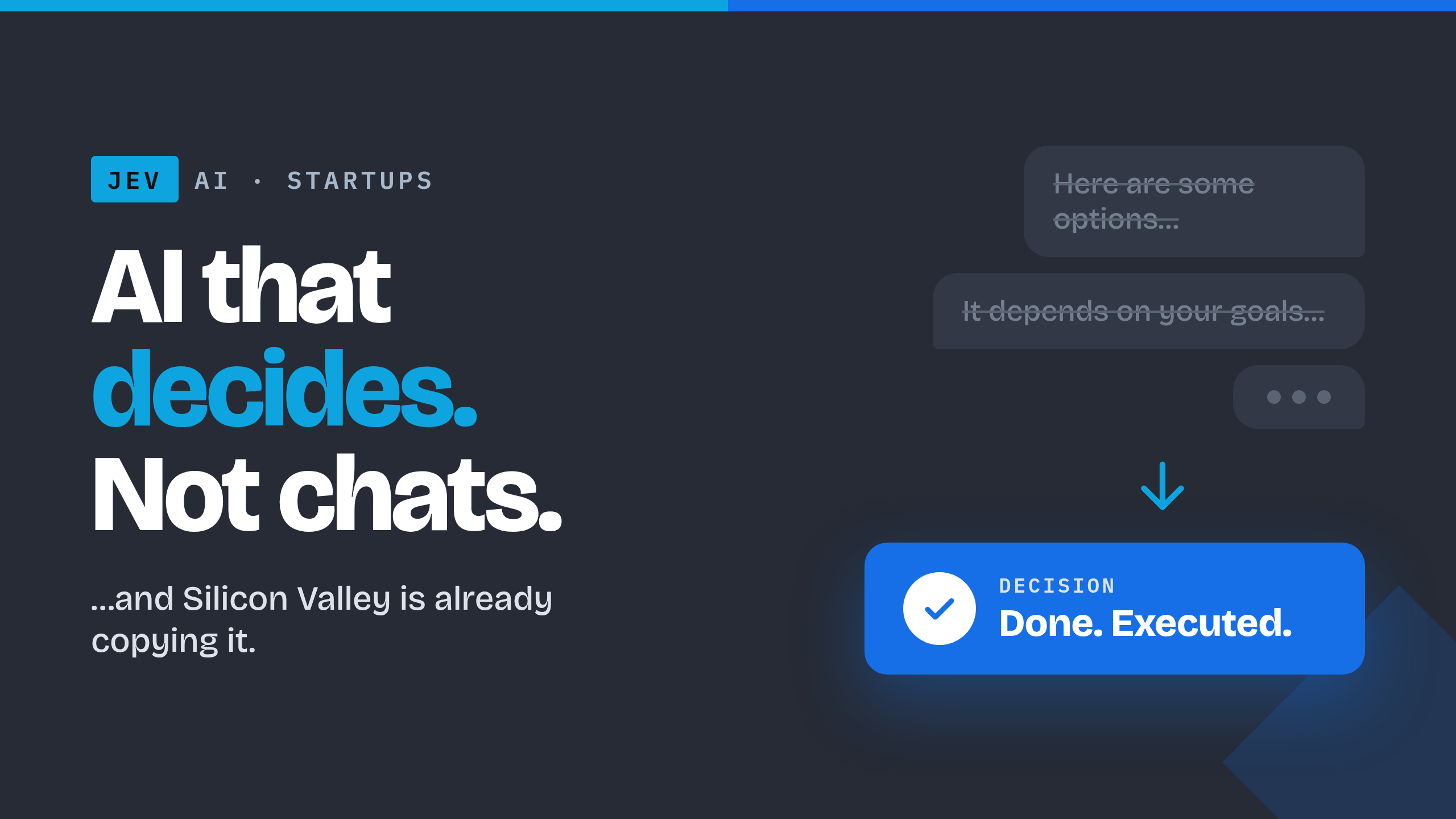
A month after launch, a small Silicon Valley startup's AI model is already running inside a quarter of the Fortune 500, and some of the biggest names in tech have rushed out look-alikes. The model is Jev, from TypeSafe AI, and its pitch is simple: for most automation work, you don't need an AI that talks. You need one that decides.
What Jev doesJev, released in early access on September 15, 2026, is a text-only model that deliberately does not chat. Instead of generating free-form text, it picks answers from a set of options the developer defines up front: yes or no, one label from a list, or a score from 0 to 100. It returns all of its answers in parallel in a single pass, and each one comes with a calibrated probability and confidence score. Each choice can include up to about 255 options.
TypeSafe calls this category "System One" models, after psychologist Daniel Kahneman's term for fast, intuitive thinking. The name Jev is a nod to economist William Stanley Jevons and the Jevons paradox: the idea that making something cheaper tends to make people use far more of it. The training technique behind it is called Reinforcement Learning for Calibrated Decisions (RLCD).
Faster and cheaper, by the company's numbersTypeSafe says Jev answers in roughly 70 to 500 milliseconds end to end, compared with several seconds for typical frontier LLMs. Input is priced at $0.042 per million tokens, and output is free. In the company's own workflow tests, Jev was up to about 190 times faster than LLMs at roughly 1/440 of the cost. These figures come from TypeSafe, not independent benchmarks, and represent the top end of its claims.
The target uses are the unglamorous plumbing of modern software: classifying and routing tickets, scoring and ranking, content moderation, and gatekeeping the actions of AI agents. The company even showed it playing Doom in real time. What Jev won't do is write emails or articles, hold a conversation, handle long reasoning, or look at images.
The founder's argumentTypeSafe's founder and CEO, Diogo Almeida, spent about four years at OpenAI working on RLHF, InstructGPT, ChatGPT and GPT-4 before leaving in 2024. Speaking to the Wall Street Journal in early October, he argued that mainstream LLMs work well enough when a human checks the output but are close to useless for real automation, because their answers are unpredictable. Software, he said, is built on dependable parts that are layered step by step, and chatbots don't behave that way.
Rapid adoptionAlmeida told the Journal that about 25% of Fortune 500 companies were already using Jev, and that a week before the interview it was processing 1 trillion tokens a day, a figure he described as growing exponentially. The launch video drew around 40 million views on X.
TypeSafe raised a $40 million seed round led by DCVC, announced alongside the launch. The Information has reported that the company is now in talks to raise more than $1 billion at a valuation reportedly in the tens of billions of dollars. Almeida declined to comment on the fundraising.
The copycats arriveThe idea has caught on fast. In late September, OpenAI launched a Decisions API built on its Luna model, which returns only answers from a user-defined set. Databricks followed a day later with an ai_decide function. Cloudflare open-sourced Clef and Clef-flash, which add a routing head to frozen Qwen base models to score candidate answers, and Amazon's earlier Strands Decider2B takes a similar approach.
Almeida says he expected imitators and believes Jev will stay ahead. He also says he hopes the launch widens the industry's conversation about alternatives to LLMs.
What to watchJev is still in early access, so its long-term reliability and whether its pricing holds up are unproven, and its headline speed and cost numbers have yet to be independently verified. But the speed of adoption, and of the response from OpenAI and others, suggests the industry sees a real gap: AI that is boring, fast, cheap and predictable may matter more to everyday software than AI that can write a sonnet.
Sources: Wall Street Journal (via Digital Today and IT Home), UD Blog, The Information.
Comments (0)
No comments yet. Be the first.