LLMs Write, Jev Decides: How TypeSafe's Jev Differs From Large Language Models
Code Industries · Oct 14, 2026 · 3 min read
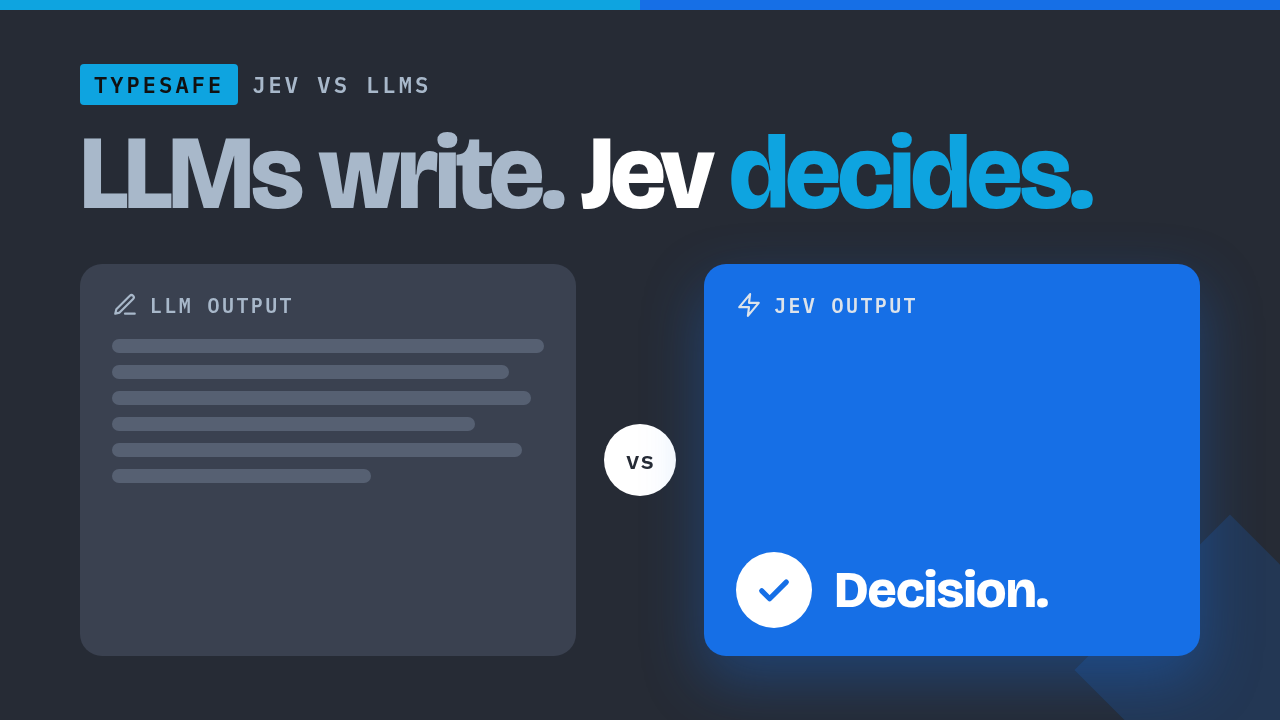
Most of the AI conversation over the past few years has been about large language models: systems that read a prompt and write back paragraphs, code, or answers in natural language. In September 2026, TypeSafe AI launched Jev, a model that deliberately does none of that. Jev never writes a sentence. It makes a decision, tells you how sure it is, and gets out of the way.
That sounds like a small change, but it reflects a different idea of what AI inside software should look like. Here's how Jev differs from the LLMs most developers already use.
It decides instead of generating
An LLM is a text generator. Whatever you ask it, the answer comes back as tokens produced one after another, and your code then has to parse that text into something it can act on.
Jev skips the text entirely. You send it some state (a support ticket, a chat message, a product listing) along with a typed question, and it returns one of three structured answers:
- Choice: pick one option from a list of up to 255.
- Score: place the input on an ordered rubric of 2 to 10 levels.
- Yes/no: return the probability that the answer is yes, from 0 to 1.
TypeSafe sums up the division of labour neatly: the LLM writes, Jev decides, and code acts.
Confidence is part of the answer
Ask an LLM a classification question and you usually get an answer stated with the same assurance whether it's right or wrong. Chat models are tuned largely on human preferences, and people tend to reward confident-sounding replies.
Jev is trained for machine consumers instead, and every answer comes with a calibrated confidence score. That changes how you build around it. Instead of trusting every output, your code can act automatically when confidence is high and send the uncertain cases to a person or to a larger model.
Built for speed and scale
Because Jev returns a decision rather than writing out a response token by token, it is fast and inexpensive to run. TypeSafe quotes response times of roughly 70 to 500 milliseconds, input pricing of $0.042 per million tokens, and no charge for output. Requests can be up to 64,000 tokens long.
Those numbers make it practical to put a model call in places where an LLM would be too slow or too costly: on every incoming support ticket, every message in a busy chat, or every step of an agent loop.
Where it fits
Jev is aimed at the high-volume, routine decisions that sit inside real products:
- Triage and routing: sorting support tickets, or choosing which model or team should handle a request.
- Moderation and monitoring: flagging messages in fast-moving chats.
- Agent control flow: letting a coding or workflow agent make quick branch decisions without a full LLM round-trip.
- Search and ranking: scoring how relevant a result is to a query.
Early adopters have reported big savings. One developer who added Jev to an AI-powered eBay search service said it was much cheaper and faster than the LLM-only setup it replaced.
What it doesn't do
Jev isn't a replacement for an LLM, and it's worth being clear about its limits:
- It can't write anything: no summaries, emails, or code.
- It reads questions literally, so how you phrase them matters.
- It struggles with numbers, counting, and date comparisons. Those belong in your code.
- It is text-only and strongest in English.
- It can be confidently wrong. Its output always has the right type, which isn't the same as being the right answer.
- Like any model that reads user input, it can be steered by injected instructions, so untrusted content needs care.
The bottom line
LLMs are generalists that think out loud in text. Jev is a specialist that answers a narrow, typed question quickly, cheaply, and with an honest estimate of its own certainty. For most teams the answer won't be choosing one over the other, but using each for what it does best: LLMs for writing and reasoning, Jev for the thousands of small decisions in between.
Comments (0)
No comments yet. Be the first.