Microsoft 365 Outage Knocks Out Outlook and Teams Across the US for More Than 12 Hours
Code Industries · Nov 13, 2026 · 4 min read
Updated Friday, November 13, 2026
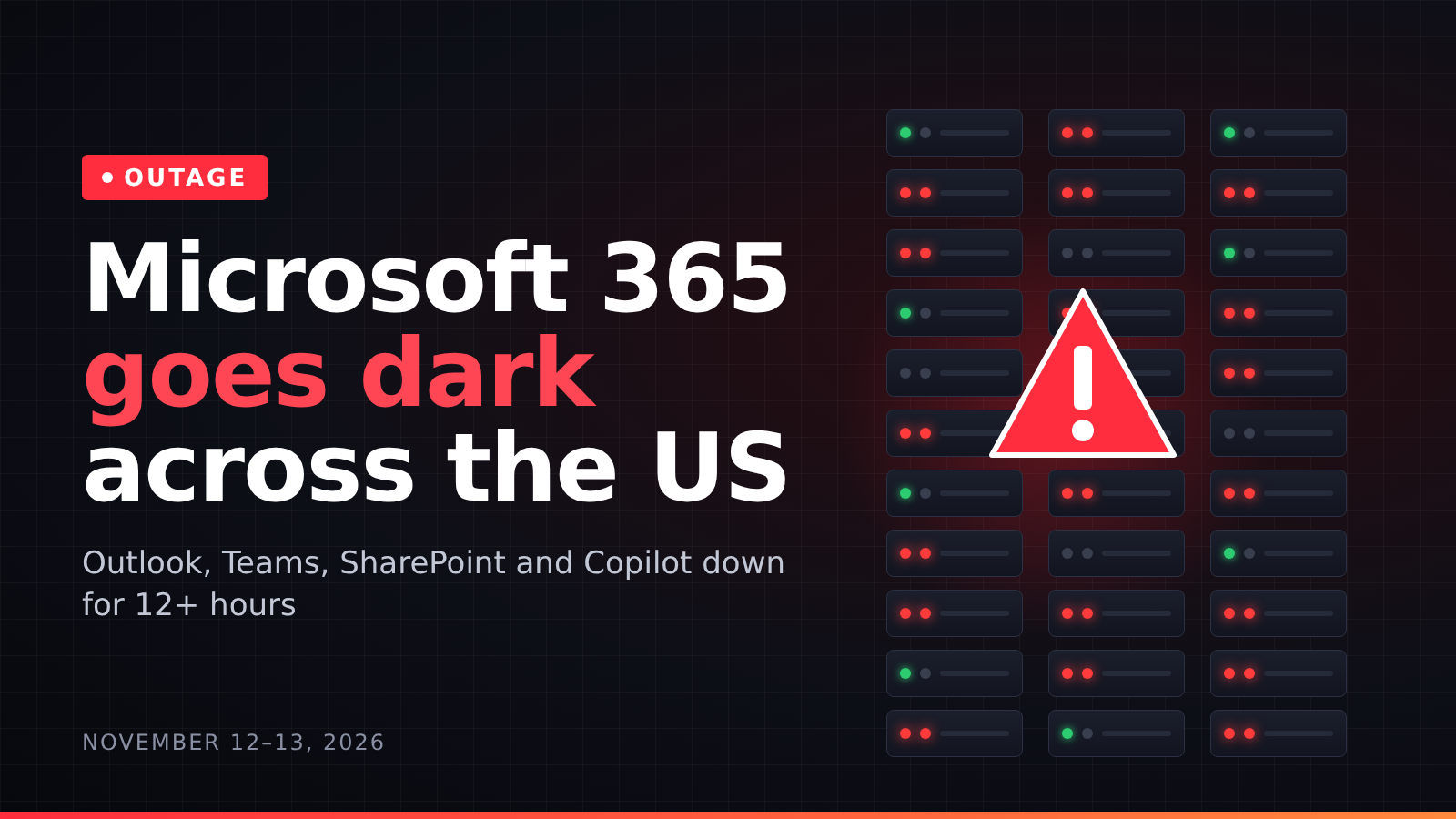
Millions of workers across the United States lost access to email, chat and shared files on Thursday afternoon when a major Microsoft 365 outage took down Outlook, Teams and a long list of related cloud services. More than 12 hours later, Microsoft still had not found a lasting fix.
How it started
Trouble began just before 1 p.m. ET on Thursday, November 12. Microsoft first said it was investigating problems with Exchange Online mailbox access "through multiple connection methods" in the Americas, tracked under incident EX1550543. Within minutes, the company widened that warning, saying the issue could affect Microsoft 365 connectivity for users in any region.
User reports climbed fast. Downdetector logged nearly 130,000 reports of Outlook problems shortly after 1 p.m. ET, and more than 45,000 for Microsoft 365 at the US peak. According to Downdetector, nearly seven in ten of all outage reports worldwide came from inside the United States, and Outlook reports peaked at more than 2,000 times their normal level. Smaller, simultaneous spikes appeared for Xbox, GitHub and LinkedIn.
What's affected
Microsoft's status page listed a wide range of services that users may be unable to connect to:
- Exchange Online and Outlook email
- Microsoft Teams
- SharePoint Online
- Microsoft 365 Copilot
- Microsoft Defender XDR and Defender for Office 365
- Microsoft Planner and Microsoft To Do
- Microsoft Intune
- Microsoft Purview and Power BI
A broader incident covering these services is tracked as MO1550821 in the Microsoft 365 admin center. Files stored directly in SharePoint Online have generally stayed reachable, but features that depend on Exchange, such as shared mailboxes and calendars, have been unreliable.
What Microsoft says caused it
Microsoft's explanation has changed as its engineers dug in.
Early on, the company pointed to "elevated load" across multiple regions. It then clarified that traffic had not actually increased. Instead, a number of servers had become unexpectedly unavailable, pushing their workload onto the remaining machines and straining them.
Late Thursday night, Microsoft said a process on the affected servers that establishes secure connections was becoming overwhelmed, causing those servers to stop processing requests. The company said it was reverting a recent network configuration change that lined up with the start of the problems, after earlier saying it had found no recent change that matched.
Microsoft has said there is "no indication" the outage is the result of malicious or cyber activity. Charles Lamanna, Microsoft's executive vice president for Copilot, Agents and Platform, said the company regrets the disruption and will share more as it learns it.
As of early Friday, Microsoft said it still had not identified the root cause.
Fixes that didn't stick
Microsoft described an aggressive but bumpy recovery effort. Over Thursday evening and night, it:
- Paused all deployments
- Moved traffic off the affected infrastructure and onto alternate routes
- Restarted affected servers and used an alternative health-check method to bring some back online
- Limited certain types of traffic in some locations
- Rebuilt a subset of servers on a previous configuration
Around 6 p.m. ET, Microsoft said some servers had returned and were stable. Hours later it warned that restored servers could become unresponsive again once traffic reached them. By late Thursday night Pacific time, it reported "partial recovery across regions" but said the recovery had not been sustained. Its most recent update said its mitigations had triggered a surge in outbound calls from routing services, and that some virtual machines stuck in a bad state were preventing changes from syncing.
Microsoft has not given an estimated time for full restoration.
Impact on US governments and businesses
The outage reached well beyond office inboxes:
- New York City: NYC Emergency Management warned of delays to email and online city services. It told residents to use other contact methods, call 311 for non-emergency services and 911 for emergencies.
- Miami Beach and Austin: City governments told residents to phone instead of emailing.
- Colorado: A sheriff's office said bond payments for people in custody were delayed.
- Corporate America: Electric vehicle maker Workhorse postponed its earnings call.
The disruption quickly went global as workdays began in Europe and Asia-Pacific, with reports from more than 70 countries and territories.
Watch out for scams
Banks have warned that scammers are posing as tech support during the outage, at a time when some of the email security tools that normally catch these messages are also affected. Microsoft will not cold-call you or ask for your password to "fix" the outage. Treat any unexpected call, text or email offering help with suspicion.
What you can do right now
- Check Microsoft's public status page at status.cloud.microsoft, or the Microsoft 365 Status account on X, for the latest updates.
- IT admins should follow incidents EX1550543 and MO1550821 in the Microsoft 365 admin center.
- If Outlook won't connect, try opening files directly from SharePoint or OneDrive, and use phone or another chat tool for urgent messages.
- Expect service to come and go as Microsoft brings servers back. A brief return of access doesn't mean the problem is over.
This is a developing story and will be updated as Microsoft shares more information.
Sources: ABC News, ABC7, ABC News (Australia), The Next Web, Windows Central, Cybersecurity News, WindowsForum, Microsoft 365 Status on X.
Comments (0)
No comments yet. Be the first.